🚢 In import and export, not all goods are shipped in containers.
🔹 Bulk Cargo refers to goods transported in large quantities, without being packed into individual bags, packages, or boxes in the conventional way. Instead, they are loaded directly into the ship’s holds or specialized tanks.
🔹 So, what types of cargo are considered bulk cargo? What does the handling process at the port involve? And what should businesses pay attention to in order to minimize additional costs and cargo shortages?
Let’s find out with A.B.A Logistics! 👇
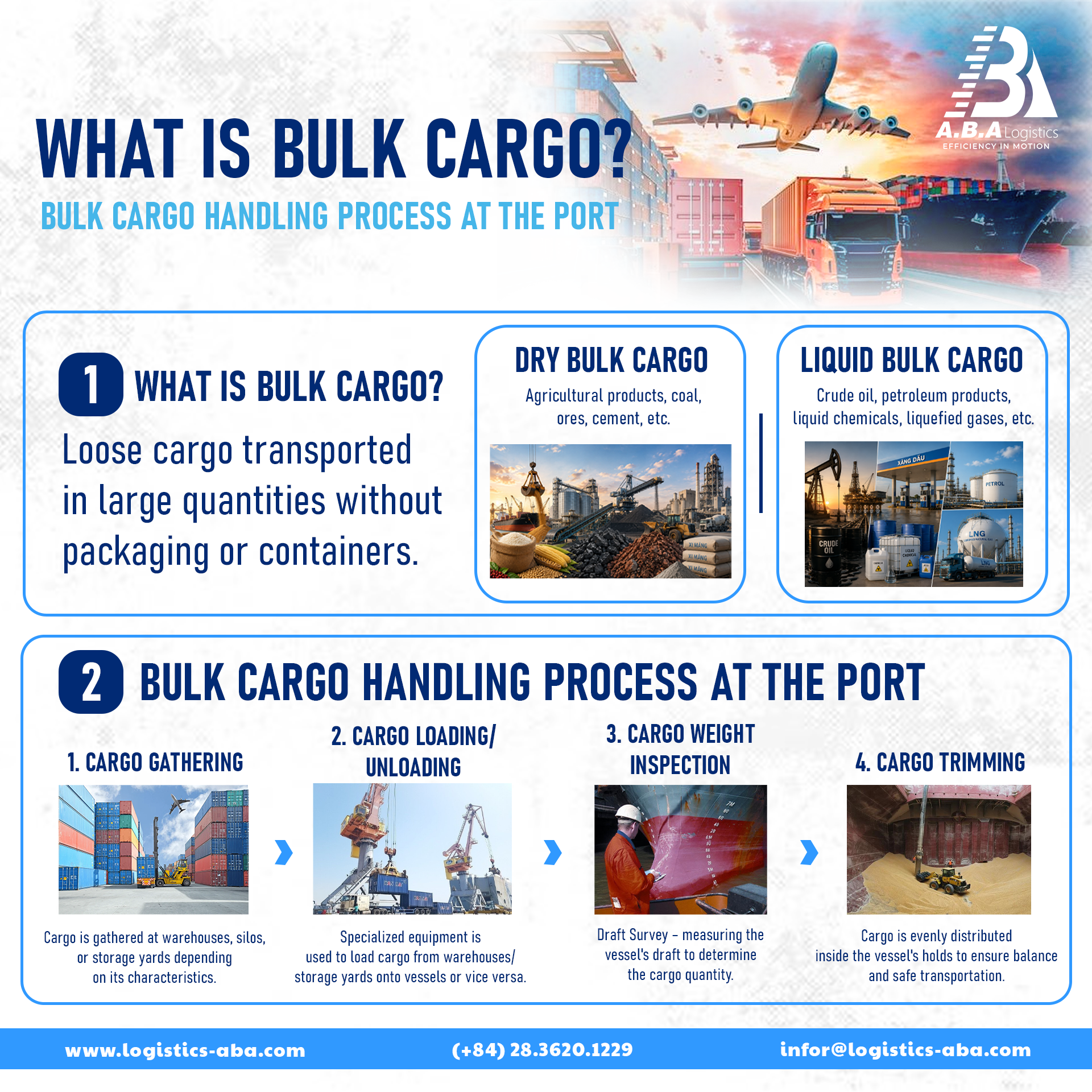
1. WHAT IS BULK CARGO?
Bulk cargo refers to goods transported directly in large quantities without being packed into individual units.
Bulk cargo can be commonly divided into two main groups:
🔹 Dry Bulk
• Rice, wheat, corn, soybeans, etc.
• Coal, iron ore, minerals, etc.
• Cement and certain industrial raw materials.
🔹 Liquid Bulk
• Crude oil, gasoline and petroleum products
• Liquid chemicals
• Liquefied gases and similar products.
Each type of cargo requires different transportation methods, storage facilities, and handling equipment.
2. BULK CARGO HANDLING PROCESS AT THE PORT
⚓ Step 1: Cargo Collection and Preparation
Cargo is delivered to warehouses, silos, or designated storage yards depending on its characteristics.
For example:
🔹 Agricultural products often require silos or enclosed warehouses to minimize moisture and mold.
🔹 Certain types of minerals can be stored in specialized yards.
Preparing cargo according to schedule is crucial, as delays may result in additional storage, yard, or vessel waiting costs.
⚓ Step 2: Cargo Loading/Unloading
Cargo is transferred from the warehouse or yard onto the vessel using specialized equipment such as conveyor belts, grabs, loading systems, and other handling equipment.
For imports, the process is carried out in reverse, from the vessel → transportation vehicles → warehouse/yard.
⚖️ Step 3: Quantity Measurement and Survey
A common method for determining the quantity of bulk cargo transported by sea is the Draft Survey.
The cargo quantity is determined based on the change in the vessel’s displacement before and after loading or unloading.
👉 This provides an important basis for reconciling cargo quantities among the parties and minimizing disputes over shortages.
⚓ Step 4: Trimming
After the cargo is loaded into the vessel’s hold, it needs to be evenly distributed to ensure proper weight distribution.
The purposes are to:
✔️ Maintain vessel stability
✔️ Minimize cargo shifting
✔️ Ensure safety during the voyage
✔️ Meet the vessel’s operational requirements.
✈️✈️✈️✈️✈️✈️
📩 Contact us today for tailored logistics solutions optimized for your business!
𝗔.𝗕.𝗔 𝗟𝗢𝗚𝗜𝗦𝗧𝗜𝗖𝗦 𝗖𝗢.,𝗟𝗧𝗗
✉️ Email: infor@logistics-aba.com
🌐 Website: https://logistics-aba.com/