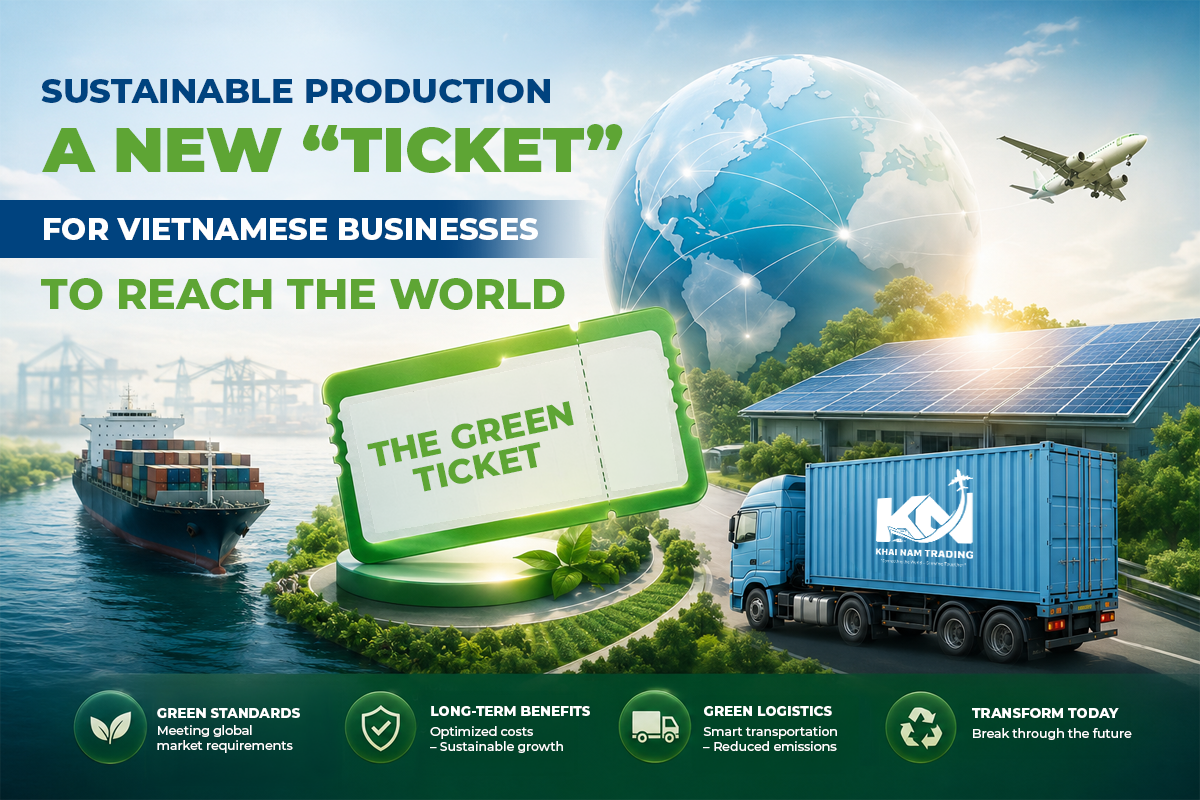
🌍 EXPORT TRENDS ARE CHANGING: quality and price are no longer the only factors determining a product’s ability to access international markets.
More and more international partners are paying attention to how businesses produce their products: where raw materials come from, how much emissions are generated, whether products and packaging can be recycled, how workers are treated, and how transparent the supply chain is.
🌍 GREEN STANDARDS ARE BECOMING A MARKET ACCESS REQUIREMENT
Next-generation FTAs such as CPTPP, EVFTA, and UKVFTA are increasingly linking trade with requirements related to the environment, labor, and social responsibility.
In the EU, exporters also need to pay attention to a number of new regulations and requirements, such as:
🔹 CBAM – Carbon Border Adjustment Mechanism
🔹 EUDR – EU Deforestation Regulation
🔹 Requirements on ecodesign, waste, and recycling
🔹 EPR – Extended Producer Responsibility
🔹 SPS standards and traceability requirements
🔹 Standards on labor, gender equality, and social responsibility
This means that the requirement for “greener” practices is no longer limited to the factory but can extend across the entire supply chain.
📦 WHAT CAN VIETNAMESE BUSINESSES GAIN BY TRANSITIONING EARLY?
Sustainable transformation certainly creates initial costs for businesses, including investment in technology, production line improvements, employee training, data collection, and management system development.
However, in the long term, this can become a competitive advantage:
✅ Increase the ability to meet the standards of FTA markets
✅ Make more effective use of tariff preferences
✅ Increase opportunities to become suppliers for international corporations
✅ Enhance product value and reputation
✅ Reduce the risk of order rejection or disruption due to failure to meet new requirements
✅ Proactively adapt as export standards continue to become more stringent
💡 LOGISTICS PERSPECTIVE
When green standards are applied throughout the supply chain, logistics is also directly affected.
Exporting businesses will need to pay greater attention to:
🔹 Transportation modes and routes
🔹 Packaging, packing, and recyclability
🔹 The origin of raw materials and supply chain data
🔹 Cargo traceability
🔹 Records, documents, and information required for compliance checks
🔹 Costs and emissions generated during transportation and warehousing
Therefore, sustainable production should be viewed as a strategy for maintaining and expanding market access, rather than simply as a requirement that businesses must meet.
Source: Ministry of Industry and Trade of Vietnam
——————✭✭✭✭✭——————
🌐 Web: https://khainamgroup.com
📨 Mail: trading@khainamgroup.com
☎ Hotline: (+84) 906 660 018