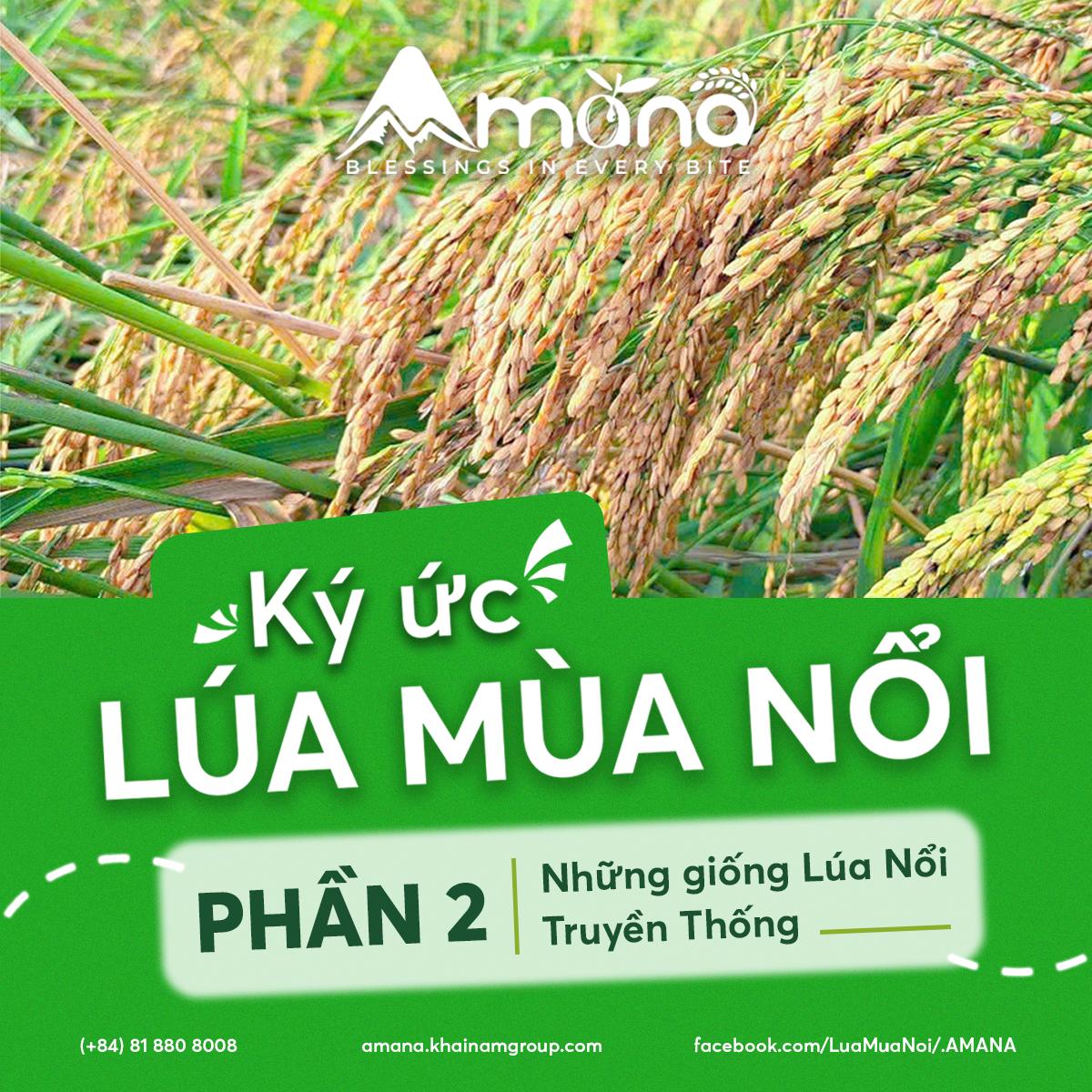
PART 2 — TRADITIONAL FLOATING RICE VARIETIES
💛 Floating rice is a unique group of rice in the Mekong Delta, deeply tied to the life, memory, and culture of the people of the Southwest region.
🌾 The first floating rice varieties such as Nàng Đùm and Nàng Phược were brought from Cambodia by Mr. Phan Văn Vàng in the late 19th century, marking a major turning point for agriculture in the Mekong region.
🌾 Floating rice, known scientifically as “Floating Rice,” is a type of rice capable of rising above rising floodwater. It includes many traditional varieties such as Nàng Tây, Nàng Đùm, Nàng Son, Nàng Rừng, Nàng Phược, Tàu Binh, Chệt Cụt, as well as Nếp Rằn and Nếp Cô Ba.
💛 The golden era of floating rice lasted from 1920 to 1960, with more than 500,000 hectares cultivated across the Long Xuyên Quadrangle (An Giang, Kiên Giang, Cần Thơ) and the Đồng Tháp Mười region (Đồng Tháp, Tiền Giang, Long An).
📍 Today, localities such as Tri Tôn (An Giang), Vĩnh Hưng (Long An), and Tân Hồng (Đồng Tháp) continue to preserve these traditional rice varieties as an essential part of the region’s memory, culture, and identity.
💛 According to MSc. Lê Thanh Phong, Deputy Director of the Institute for Climate Change at An Giang University, 300 floating rice varieties are currently being conserved, and two distinctive Vietnamese varieties—Hương Lài and Nàng Tây Đùm—have been successfully developed, offering clean, soft, and fragrant rice.
This presents an opportunity to revive floating rice in a time when agriculture prioritizes quality, safety, and climate resilience.
Source: Compiled
——–
🔸Web: https://amana.khainamgroup.com
🔸Mail: amana@khainamgroup.com